
AI in Pop Culture
 Scientists have been developing AI since the advent of computers in the 1950s.
Science Fiction stories dating back to the late 19th century – e.g. Samuel Butler’s 1872 novel Erewhon, George Eliot in a chapter of her final published work Impressions of Theophrastus Such (1879) and Mary Shelley’s 1818 Frankenstein suggest an intelligence that is not human.
In more recent years books such as I, Robot by American writer Isaac Asimov gave us the Three Laws of Robotics which had an influence on later science fiction an impact on thought on ethics of artificial intelligence as well.
Asimov’s Three Laws of Robotics:
- A robot may not injure a human being or, through inaction, allow a human being to come to harm.
- A robot must obey the orders given it by human beings except where such orders would conflict with the First Law.
- A robot must protect its own existence as long as such protection does not conflict with the First or Second Law.
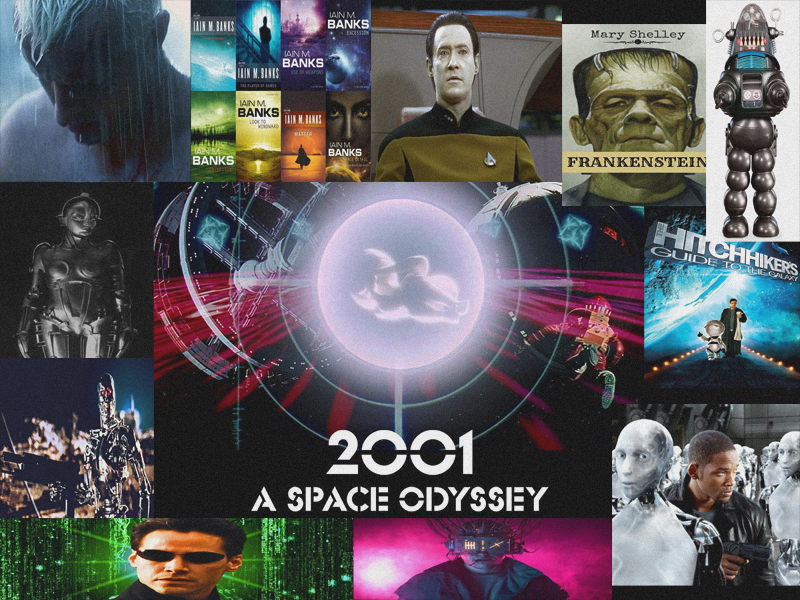
Films such as Stanley Kubrick’s 1968 2001: A Space Odyssey with its murderous on-board computer HAL 9000, contrasting with the more benign R2-D2 in George Lucas’s 1977 Star Wars and the eponymous robot in Pixar’s 2008 WALL-E.
For the most part these stories can be broken down into, Utopian visions of the future with benign AI and Dystopian visions of the future with malignant AI
1: Utopian Visions / Benign AI:
- Robbie the Robot, first seen in Forbidden Planet in 1956; later in the 1960s with Lost in Space
- Data in Star Trek: The Next Generation from 1987 to 1994
- Pixar’s WALL-E in 2008.
- Iain M. Banks’s Culture series of novels portrays a Utopian, post-scarcity space society of humanoids, aliens, and advanced beings with artificial intelligence living in socialist habitats across the Milky Way.
Researchers at the University of Cambridge have identified four major themes in Utopian scenarios featuring AI:
- Immortality, or indefinite lifespans;
- Ease, or freedom from the need to work;
- Gratification, or pleasure and entertainment provided by machines
- Dominance, the power to protect oneself or rule over others.
- Dystopian visions / Malignant AI:
- Frankenstein, the 1931 film
- Metropolis, by Fritz Lang in 1927 film
- 2001 a Space Odyssey, film
- Do Androids Dream of Electric Sheep? Book by Philip K. Dick – interpreted in Ridley Scott’s film Bladerunner in 1982
- The Hitchhiker’s Guide to the Galaxy, Book & TV Series by Douglas Adams
- I, Robot Books by Isaac Asimov 1940 – 1950
- Neuromancer Book by William Gibson in 1984
- The Matrix by Lana Wachowski and Lilly Wachowski in 1999
- The Diamond Age by Neal Stephenson in 1995
- Terminator by James Cameron in 1984
- Artificial Intelligence Film by Steven Spielberg 2001
- I, Robot Film by Alex Proyas 2004
- The Netflix series ‘Person of Interest’ by Jonathan Nolan (2013 – 2016)
A common theme in many science fiction stories concerning AI is the idea that creating a ‘super-intelligent’ being is dangerous purely because it is so much smarter than us mere mortals and will (sooner or later) usurp us humans and become the dominant life form (e.g. Skynet in the Terminator films). Of course, another popular theme is that AI just doesn’t care about humans (Neuromancer 1984) and is only really concerned with its own existence. This raises an important philosophical question, ‘are we creating a new species of sentient beings (i.e. Playing God)?’
The stories told in the books, TV programmes and films about AI draw attention to the many issues scientists, commentators, influencers and politicians have been focusing on. There have been scores of media reports concerning the existential threat to us humans posed by creating a “Super-Intelligence.”