
Machine Learning, Deep Learning and Generative AI
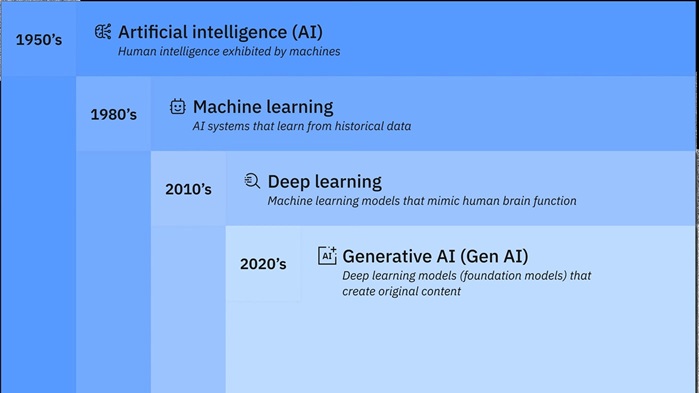
Since 2024, most AI researchers, practitioners and most AI-related headlines were focused on breakthroughs in Generative AI (gen AI), a technology that can create:
- original text
- images
- video and
- other content
To fully understand generative AI, it’s important to first understand the technologies on which generative AI tools are built: Machine Learning (ML) and Deep Learning.
Machine Learning
‘Machine Learning (ML) involves decisions and predictions based on data (statistical analysis). This is something the machine ‘learns’, rather than being programmed.’
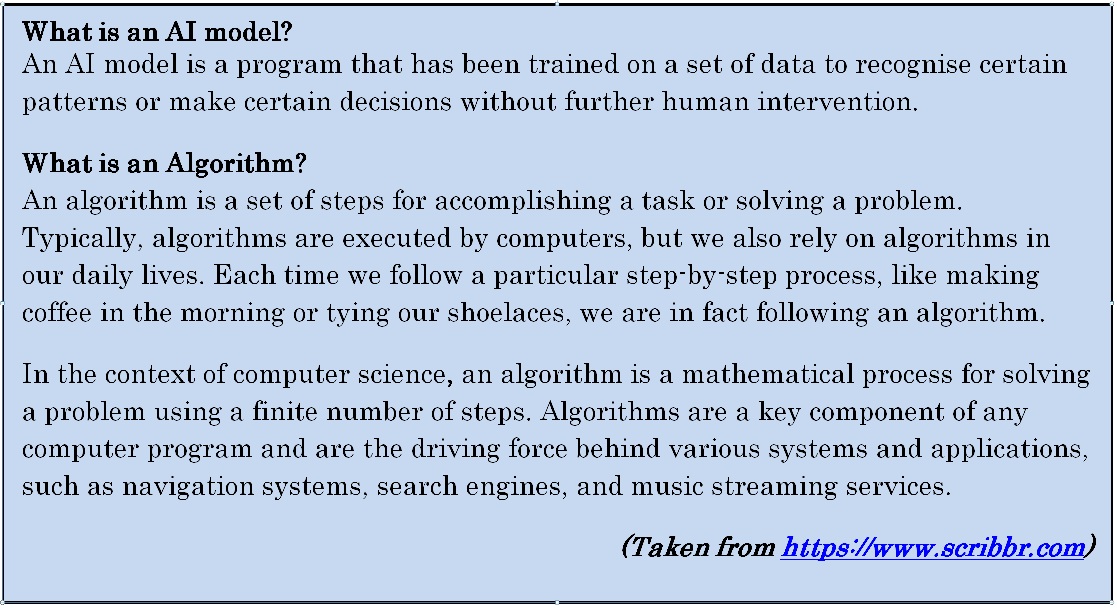
Machine Learning involves creating models (see below) by training an algorithm (see below) to make predictions or decisions based on data (information). It encompasses a broad range of techniques that enable computers to learn from and make inferences based on data without being explicitly programmed for specific tasks.
There are 2 types of Machine Learning:
- Supervised Machine Learning
- Unsupervised Machine Learning.
There are many types of machine learning techniques or algorithms but one of the most popular types of machine learning algorithm is called a neural network .
Neural networks are modeled after the human brain’s structure and function. A neural network consists of interconnected layers of nodes (analogous to neurons) that work together to process and analyse complex data.

Deep Learning
Deep learning is a subset of machine learning that uses multi-layered neural networks, called Deep Neural Networks that more closely simulate the complex decision-making power of the human brain.
Deep neural networks include an input layer, at least three but usually hundreds of hidden layers, and an output layer, unlike neural networks used in classic machine learning models, which usually have only one or two hidden layers.
These multiple layers enable Unsupervised Learning: they can automate the extraction of features from large, unlabelled and unstructured data sets, and make their own predictions about what the data represents.
Because deep learning doesn’t require human intervention, it enables machine learning at a tremendous scale. It is well suited to tasks that involve the fast, accurate identification of complex patterns and relationships in large amounts of data. Some form of deep learning powers most of the artificial intelligence (AI) applications in our lives today.
 Generative AI
Generative AI, sometimes called “gen AI”, refers to deep learning models that can create complex original content such as long-form text, high-quality images, realistic video or audio and more in response to a user’s prompt or request.
At a high level, generative models encode a simplified representation of their training data, and then draw from that representation to create new work that’s similar, but not identical, to the original data.
How generative AI works
In general, generative AI operates in three phases:
- Training, to create a foundation model.
- Tuning, to adapt the model to a specific application.
- Generation, evaluation and more tuning, to improve accuracy.
1. Training
Generative AI begins with a “foundation model”; a deep learning model that serves as the basis for multiple different types of generative AI applications.
The most common foundation models today are Large Language Models (LLMs), created for text generation applications. But there are also foundation models for image, video, sound or music generation, and multimodal foundation models that support several kinds of content.

2. Tuning
Next, the model must be tuned to a specific content generation task. This can be done in various ways, including:
- Fine-tuning, which involves feeding the model application-specific labeled data, questions or prompts the application is likely to receive, and corresponding correct answers in the wanted format.
- Reinforcement learning with human feedback (RLHF), in which human users evaluate the accuracy or relevance of model outputs so that the model can improve itself. This can be as simple as having people type or talk back corrections to a chatbot or virtual assistant.
3. Generation, evaluation and more tuning
Developers and users regularly assess the outputs of their generative AI apps, and further tune the model even as often as once a week for greater accuracy or relevance. In contrast, the foundation model itself is updated much less frequently, perhaps every year or 18 months.
AI Agents and Agentic AI
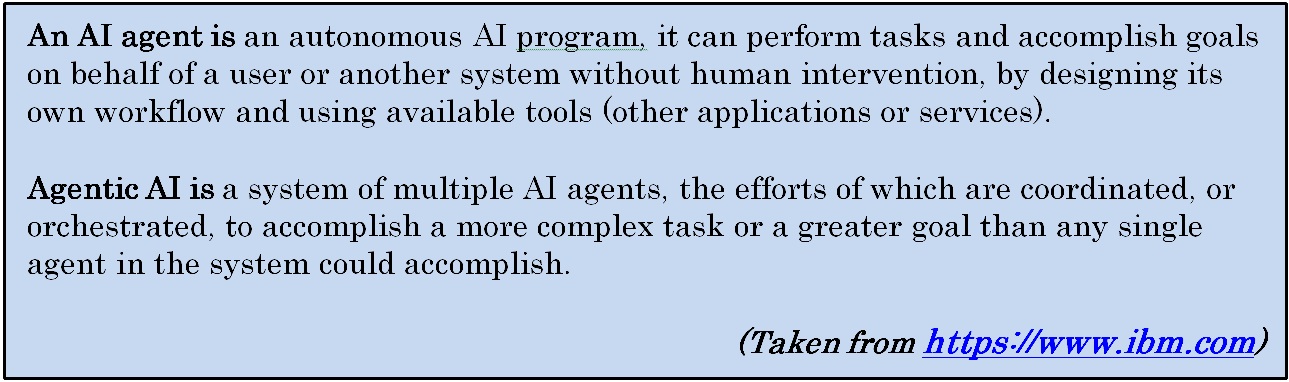
Unlike chatbots and other AI models which operate within predefined constraints and require human intervention, AI agents and agentic AI exhibit autonomy, goal-driven behaviour and adaptability to changing circumstances. The terms “agent” and “agentic” refer to these models’ agency, or their capacity to act independently and purposefully.
One way to think of agents is as a natural next step after generative AI. Gen AI models focus on creating content based on learned patterns; agents use that content to interact with each other and other tools to make decisions, solve problems and complete tasks.